Scrape Historical Grocery Price Data - Amazon & Walmart Products.
What Competitive Edge Can You Build When You Scrape Historical Grocery Price Data — Amazon & Walmart Products?
Introduction
The grocery retail landscape has rapidly evolved as Amazon and Walmart dominate the online grocery ecosystem. With digital shelves replacing traditional aisles, pricing for everyday essentials such as milk, cereals, beverages, snacks, and fresh produce changes dynamically based on demand patterns, supply chain shifts, competitive pressure, and automated pricing algorithms. In this data-driven environment, businesses need more than surface-level insights. Historical Grocery Price Data Scraping For Amazon And Walmart provides the long-term visibility required to understand pricing behavior over time. Companies that strategically Scrape Historical Grocery Price Data — Amazon & Walmart Products gain access to structured datasets that reveal seasonal trends, discount cycles, and regional pricing variations. Through systematic Amazon & Walmart Grocery Price History Data Extraction, organizations move beyond temporary price checks and build reliable historical archives. The ability to consistently Track Historical Grocery Price Changes On Amazon & Walmart empowers brands and retailers to shift from reactive pricing decisions toward predictive, data-backed strategic planning.
The Growing Importance of Historical Grocery Pricing Intelligence
Unlike traditional retail models where prices changed weekly or monthly, online grocery pricing can shift multiple times per day. Retail giants adjust prices based on competitor actions, regional demand, inventory levels, and promotional campaigns. Without historical tracking, businesses only see the present moment and miss the larger pricing narrative.
When companies systematically Extract Historical Grocery Prices For Amazon & Walmart Products, they uncover valuable time-series data. This historical insight reveals seasonal pricing cycles, recurring promotional trends, price elasticity patterns, and inflation-driven adjustments. Over time, these insights allow organizations to forecast price movements and optimize strategy with confidence.
Historical pricing data also strengthens negotiation leverage with suppliers and improves private-label positioning. By analyzing competitor discount frequency and duration, businesses can better structure promotional campaigns and pricing models.
How Grocery Data Scraping Works in Practice?
Modern Web Scraping Grocery Data techniques rely on automated extraction systems that collect structured information directly from online grocery platforms. These systems capture product names, brand details, category classifications, pricing information, discount percentages, availability status, delivery charges, and location-based price variations.
APIs play a crucial role in scaling this process. The Amazon Grocery Delivery Scraping API enables systematic extraction of pricing and availability data across different ZIP codes and regions. Similarly, the Walmart Grocery Delivery Scraping API allows large-scale monitoring of Walmart’s grocery catalog, ensuring businesses receive consistent and timestamped pricing records.
A robust Grocery Delivery Extraction API automates daily or hourly data collection, helping organizations build comprehensive historical archives. This automation ensures that no short-term discount, flash sale, or price fluctuation goes unnoticed.
Strategic Applications of Historical Grocery Price Data
Historical grocery pricing intelligence serves multiple strategic functions across the retail ecosystem.
First, it enhances competitive benchmarking. By analyzing past price movements, businesses can determine whether competitors frequently undercut prices, deploy loss-leader strategies, or align with price-matching policies. This level of visibility prevents pricing blind spots and supports more accurate market positioning.
Second, historical data supports promotional analysis. Retailers often deploy time-bound discounts tied to festivals, seasonal demand, or inventory clearance. Long-term price tracking reveals the frequency, depth, and duration of these campaigns. This knowledge allows brands to time their promotions more effectively and avoid margin erosion.
Third, price history enables advanced demand forecasting. When pricing data is combined with sales performance metrics, analysts can model price elasticity and simulate different pricing scenarios. This strengthens revenue planning and helps predict customer response to discounts.
Finally, historical tracking provides regional pricing intelligence. Amazon and Walmart often implement location-specific pricing strategies influenced by local competition and logistics costs. Monitoring these differences helps brands tailor market entry and expansion strategies.
Transforming Raw Data into Actionable Insights
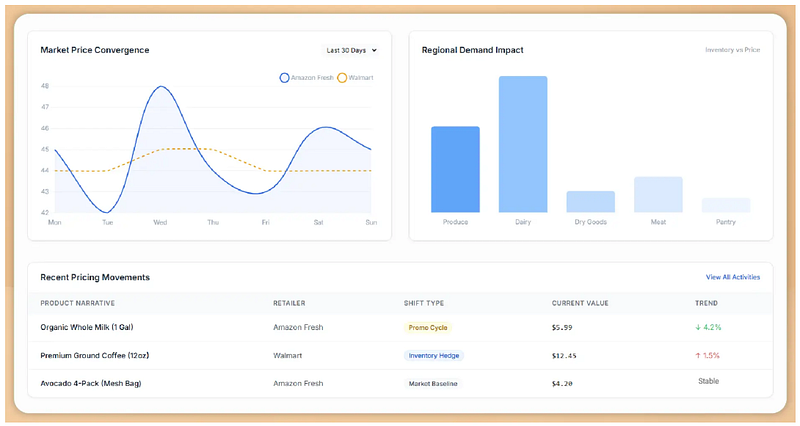
Collecting data is only the first step. The real value emerges when organizations transform historical records into structured analytics systems. A well-designed Grocery Price Dashboard visualizes long-term pricing trends, category-level volatility, and competitor comparison metrics.
Dashboards provide leadership teams with real-time monitoring capabilities while maintaining access to historical archives. Instead of manually reviewing spreadsheets, decision-makers can quickly assess whether a price shift is seasonal, competitive, or supply-driven.
Over time, these dashboards become strategic command centers for pricing optimization.
The Long-Term Value of Historical Grocery Data
The true power of historical grocery price tracking lies in compounding insight. A few weeks of data may reveal minor fluctuations, but multi-year datasets uncover structural patterns. For example, certain product categories may consistently experience price increases during specific quarters due to commodity shifts. Others may show stable pricing due to private-label competition.
Sustained data collection builds strong Grocery Data Intelligence, allowing organizations to anticipate trends instead of reacting to them. Structured Grocery Datasets also support integration with machine learning systems, enabling predictive modeling and automated pricing recommendations.
In a market defined by thin margins and intense competition, long-term historical visibility becomes a measurable competitive advantage.
Addressing Technical and Operational Challenges
Grocery platforms are complex digital environments that frequently update their structures. Dynamic pricing engines, region-based filters, and anti-bot mechanisms add layers of complexity to data extraction. Professional infrastructure ensures stability, accuracy, and compliance in large-scale scraping operations.
By implementing resilient extraction frameworks, businesses maintain uninterrupted access to reliable historical datasets without manual monitoring burdens.
How Food Data Scrape Can Help You?
- Comprehensive Historical Price Monitoring
Our data scraping services continuously collect structured grocery pricing data from Amazon and Walmart, helping you analyze long-term trends, seasonal fluctuations, competitor discounts, and dynamic pricing strategies accurately. - Real-Time Competitive Intelligence
We deliver automated price tracking that enables you to monitor competitor movements instantly, identify undercutting strategies, respond to promotional campaigns quickly, and maintain optimal pricing competitiveness across regions. - Advanced Analytics & Dashboard Integration
Our structured datasets integrate seamlessly with your BI tools, enabling custom dashboards, trend visualizations, price volatility tracking, and data-driven forecasting models for smarter business decisions. - Regional & Category-Level Insights
We extract location-based grocery pricing data across categories, helping you understand regional variations, optimize localized strategies, benchmark category performance, and refine expansion planning with reliable intelligence. - Scalable, Automated Data Infrastructure
Our scalable scraping infrastructure ensures accurate, automated, and scheduled data delivery, minimizing manual effort while providing consistent, high-quality historical grocery datasets for long-term strategic growth.
Conclusion
Online grocery retail will only become more algorithm-driven and competitive. Companies that rely solely on present-day pricing data risk missing broader market trends and competitor strategies.
A comprehensive Grocery Price Tracking Dashboard ensures continuous monitoring and long-term analytical depth. With strong historical foundations, organizations build powerful forecasting models and sharper competitive positioning.
Ultimately, structured historical pricing archives fuel sustainable Grocery Data Intelligence, enabling smarter decisions across pricing, promotions, and expansion strategies. Businesses equipped with robust Grocery Datasets are better prepared to navigate volatility, protect margins, and lead in the rapidly evolving digital grocery marketplace.
In today’s retail landscape, historical grocery price data is not just informative — it is transformational strategic capital.
Are you in need of high-class scraping services? Food Data Scrape should be your first point of call. We are undoubtedly the best in Food Data Aggregator and Mobile Grocery App Scraping service and we render impeccable data insights and analytics for strategic decision-making. With a legacy of excellence as our backbone, we help companies become data-driven, fueling their development. Please take advantage of our tailored solutions that will add value to your business. Contact us today to unlock the value of your data.
Read More>>https://www.fooddatascrape.com/grocery-mobile-app-data-scraping.php
#ScrapeHistoricalGroceryPriceDataAmazonAndWalmartProducts
#HistoricalGroceryPriceDataScrapingForAmazonAndWalmart
#AmazonAndWalmartGroceryPriceHistoryDataExtraction
#TrackHistoricalGroceryPriceChangesOnAmazonAndWalmart
#ExtractHistoricalGroceryPricesForAmazonAndWalmartProducts
#AmazonGroceryDeliveryScrapingAPI
#WalmartGroceryDeliveryScrapingAPI


Comments
Post a Comment