Extract Restaurants Data from OpenRice Hong Kong.
Why Is It Important to Extract Restaurants Data from OpenRice Hong Kong for Restaurant Data Analytics?
Introduction
Hong Kong’s food industry is one of the most competitive and fast-evolving restaurant markets in the world. Thousands of restaurants compete for attention, and consumers actively rely on digital platforms to explore menus, compare prices, and read reviews before choosing where to dine. Among these platforms, OpenRice has become a major hub for restaurant discovery, reviews, and food delivery information. Businesses, market researchers, and analytics teams increasingly rely on structured data from such platforms to understand dining trends, pricing strategies, and customer sentiment.
In this data-driven environment, companies are investing in advanced data extraction technologies to gather accurate and actionable insights. Solutions that enable to Extract Restaurants Data from OpenRice Hong Kong allow businesses to analyze restaurant listings, menus, pricing trends, customer reviews, and promotional offers at scale. By using specialized tools for OpenRice Hong Kong Data Scraping, organizations can systematically collect and analyze food industry information that supports strategic decision-making. Furthermore, modern platforms for OpenRice Hong Kong Food Data Extraction help convert raw restaurant information into structured datasets that power analytics dashboards, competitive benchmarking, and food market intelligence.
This blog explores how extracting restaurant data from OpenRice Hong Kong works, the types of information available, and how businesses can leverage this data to gain meaningful insights.
Understanding the Value of OpenRice Restaurant Data
OpenRice is widely recognized as a leading restaurant discovery and review platform in Hong Kong. It provides comprehensive information about restaurants, including menus, ratings, customer feedback, location details, and dining promotions. For businesses in the food industry, hospitality sector, and market research domain, OpenRice data represents a valuable source of insights.
Organizations use extracted data to understand customer preferences, identify emerging food trends, and monitor competitor activities. Restaurant chains analyze pricing patterns and menu variations, while food delivery platforms evaluate restaurant popularity and consumer demand.
With advanced tools for OpenRice HK Restaurant Review Data Extraction, companies can gather large volumes of customer feedback data and perform sentiment analysis to understand how diners perceive restaurants, dishes, and services. This information is especially useful for restaurant brands looking to improve customer experience or evaluate market perception.
In addition, digital menu tracking solutions such as OpenRice Hong Kong Digital Menu Monitoring allow businesses to observe menu changes, price adjustments, and seasonal offerings in real time. This helps restaurants stay competitive while enabling analytics teams to detect pricing trends and food category demand.
Types of Data That Can Be Extracted from OpenRice Hong Kong
Restaurant data extraction solutions capture a wide range of structured and unstructured information from OpenRice listings. These datasets help companies perform comprehensive restaurant intelligence analysis.
Some commonly extracted data fields include:
- Restaurant names, categories, and cuisine types
- Menu items, dish descriptions, and prices
- Customer ratings and detailed reviews
- Restaurant locations, contact information, and operating hours
- Special offers, promotions, and seasonal menu items
- Food delivery availability and estimated delivery times
Advanced data pipelines powered by OpenRice Food Delivery Scraping API, businesses can monitor delivery-enabled restaurants, analyze menu pricing for delivery orders, and track promotional discounts offered through online platforms.
Moreover, professional OpenRice Food Delivery App Data Scraping Services enable organizations to collect large volumes of delivery-related data from OpenRice’s digital ecosystem. These datasets support analytics for food delivery platforms, restaurant chains, and market research companies.
When combined with advanced analytics tools, Web Scraping Food Delivery Data provides valuable insights into delivery demand patterns, service areas, and the competitive positioning of restaurants offering online ordering.
Benefits of Extracting OpenRice Hong Kong Restaurant Data
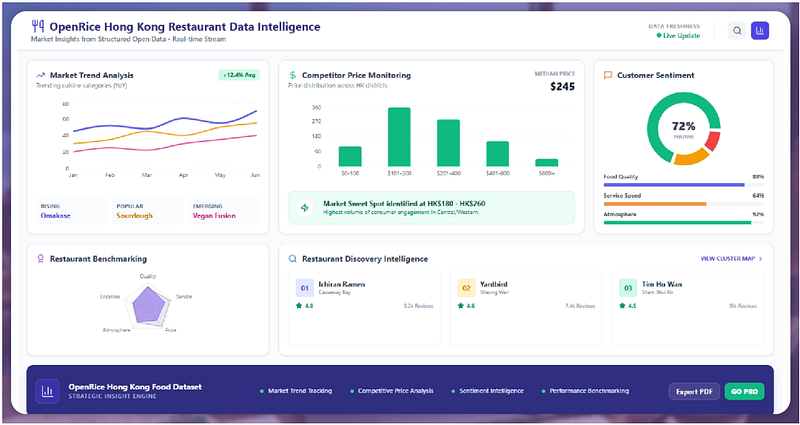
Restaurant data scraping offers numerous advantages for businesses operating in the food and hospitality ecosystem. By transforming publicly available restaurant information into structured datasets, companies gain access to insights that would otherwise be difficult to analyze manually.
Key benefits include:
- Market Trend Analysis
- Extracted datasets reveal which cuisines, dishes, and restaurant concepts are gaining popularity in Hong Kong. Businesses can adapt their offerings accordingly.
- Competitor Price Monitoring
- Restaurant owners can compare menu prices across competitors and evaluate how their pricing strategy fits within the local market.
- Customer Sentiment Insights
- Review data helps brands understand diner experiences and identify recurring complaints or highly praised menu items.
- Restaurant Discovery and Benchmarking
- Investors and restaurant groups can identify top-performing restaurants based on ratings, popularity, and customer engagement.
By building an extensive OpenRice Food Dataset from Hong Kong, organizations gain deeper visibility into the food market ecosystem and can make more informed operational and strategic decisions.
Key Steps Involved in Extracting OpenRice Restaurant Data
Building a reliable data extraction pipeline requires careful planning, the right tools, and efficient data processing techniques. The typical workflow for extracting restaurant data from OpenRice involves several steps.
- Data Source Identification
The first step involves identifying relevant OpenRice pages that contain restaurant listings, menu information, customer reviews, and delivery details. - Data Extraction
Specialized scraping scripts or APIs collect structured data from these pages. This stage focuses on capturing restaurant profiles, menus, ratings, and other information. - Data Cleaning and Structuring
Raw extracted data often requires cleaning, formatting, and normalization to ensure consistency across datasets. - Menu and Pricing Analysis
Once structured, the data can be used to Extract Restaurant Menu Data and evaluate pricing patterns, dish popularity, and menu variations across restaurants. - Data Storage and Integration
The processed data is stored in databases or analytics platforms where it can support dashboards, reports, and predictive analytics models.
Applications of OpenRice Restaurant Data in Business Analytics
Extracted restaurant datasets play an important role in modern food industry analytics. Businesses across different sectors rely on these insights to improve strategy and performance.
One of the most important use cases is competitive benchmarking. Restaurants can analyze competitor menus, pricing, and promotions to identify opportunities for differentiation. Additionally, food aggregators and delivery platforms use restaurant data to evaluate which restaurants should be onboarded in specific regions.
Another key application involves demand forecasting. With historical data from platforms like OpenRice, businesses can identify seasonal trends in cuisine popularity and adjust inventory, staffing, and marketing strategies accordingly.
Companies that implement advanced Food Delivery Scraping API systems can also integrate restaurant datasets with other market intelligence tools. This integration helps organizations build powerful analytics dashboards that visualize restaurant performance metrics and market dynamics.
Furthermore, restaurant data insights contribute significantly to Restaurant Data Intelligence initiatives. These initiatives combine structured datasets, customer feedback analysis, and pricing data to provide a comprehensive view of the food industry landscape.
Challenges in Extracting Restaurant Data
While restaurant data scraping offers numerous benefits, organizations must address several technical and operational challenges.
Data consistency is a common issue, as restaurant listings may contain variations in menu formatting or incomplete information. Additionally, maintaining up-to-date datasets requires regular monitoring and automated scraping pipelines.
Another challenge is ensuring compliance with platform policies and legal regulations while collecting publicly available data. Businesses must implement responsible data extraction practices and ensure ethical use of the collected datasets.
Despite these challenges, modern data engineering solutions and scalable scraping frameworks make it possible to build reliable restaurant data pipelines that deliver accurate insights.
How Food Data Scrape Can Help You?
- Comprehensive Restaurant Data Collection
Our advanced scraping solutions collect restaurant listings, menus, ratings, reviews, pricing, and delivery details, helping businesses build accurate datasets for analysis. - Real-Time Menu and Price Monitoring
We continuously monitor restaurant menus and pricing changes across platforms, enabling businesses to track competitors and adjust strategies quickly. - Scalable Data Extraction for Large Datasets
Our infrastructure supports high-volume scraping projects, ensuring reliable extraction of thousands of restaurant records without compromising data accuracy. - Structured and Analytics-Ready Data Delivery
We deliver clean, structured datasets in formats like JSON, CSV, or API integrations, simplifying analysis, reporting, and business intelligence implementation. - Custom Data Insights for Food Industry Growth
Our tailored scraping services help restaurants, aggregators, and researchers uncover trends, customer preferences, and competitive insights for smarter decisions.
Conclusion
The food industry is becoming increasingly data-driven, and platforms like OpenRice provide a rich source of information about restaurants, menus, customer preferences, and delivery services. Extracting structured data from these platforms enables businesses to gain deep insights into market trends, consumer behavior, and competitive dynamics.
With the help of advanced scraping tools and analytics platforms, organizations can transform OpenRice restaurant listings into actionable intelligence. From menu monitoring and price tracking to review analysis and delivery insights, restaurant datasets offer valuable opportunities for data-driven decision-making.
As companies continue to invest in food analytics, solutions that combine restaurant data extraction with advanced dashboards will become even more important. Integrating restaurant datasets into Food delivery Intelligence platforms enables businesses to track market trends and optimize operations. Additionally, interactive analytics tools such as a Food Price Dashboard allow decision-makers to monitor menu pricing changes in real time. By leveraging structured Food Datasets, organizations can unlock powerful insights that drive innovation, improve customer experiences, and strengthen their competitive position in the evolving food industry.
If you are seeking for a reliable data scraping services, Food Data Scrape is at your service. We hold prominence in Food Data Aggregator and Mobile Restaurant App Scraping with impeccable data analysis for strategic decision-making.
Read More>>https://www.fooddatascrape.com/openrice-restaurant-data-scraping.php
#ExtractRestaurantsDataFromOpenRiceHongKong
#OpenRiceHongKongDataScraping
#OpenRiceHongKongFoodDataExtraction
#OpenRiceHKRestaurantReviewDataExtraction
#OpenRiceHongKongDigitalMenuMonitoring
#OpenRiceHongKongRestaurantIntelligenceAPI
#OpenRiceHKStructuredRestaurantDataScraper
#OpenRiceFoodDatasetFromHongKong
#OpenRiceFoodDeliveryScrapingAPI
#OpenRiceFoodDeliveryAppDataScrapingServices


Comments
Post a Comment