Zomato API Data Scraping for Restaurant, Menu & Pricing Analytics
Leveraging Zomato API Data Scraping to Power Scalable Restaurant, Menu, and Pricing Analytics

Introduction
The online food delivery ecosystem is driven by real-time data — from restaurant menus and item prices to discounts, ratings, and customer reviews. Among all platforms, Zomato stands out as one of the most data-rich food delivery marketplaces, generating continuous streams of restaurant and consumer interaction data.
However, manually tracking menu changes, pricing updates, and competitive shifts across thousands of restaurants is impossible. This is where Zomato API data scraping becomes essential.
By leveraging Zomato API data extraction, businesses can build scalable restaurant analytics, menu intelligence systems, and pricing dashboards that evolve in real time.
At Food Data Scrape, we help brands, restaurant chains, cloud kitchens, and research firms harness Zomato API data scraping solutions to convert raw platform data into structured, analytics-ready intelligence.
What Is Zomato API Data Scraping?
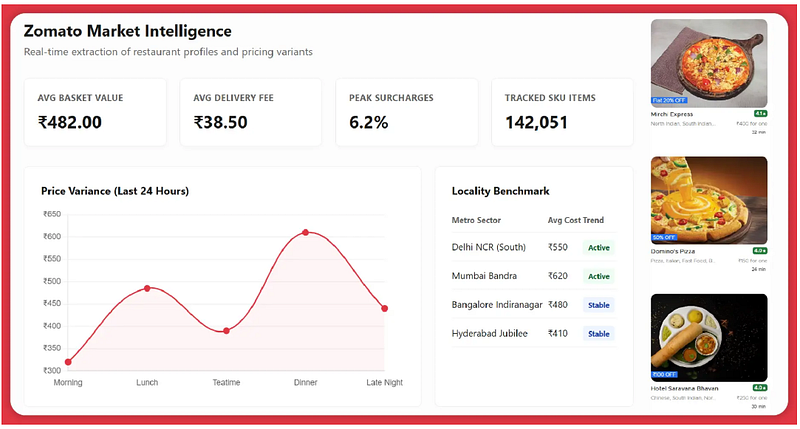
Zomato API data scraping refers to extracting structured data from Zomato’s API or API-like mobile app endpoints to capture restaurant, menu, pricing, and review information at scale.
Using advanced Zomato API scraping techniques, Food Data Scrape extracts:
- Restaurant profiles and metadata
- Menu categories and item listings
- Item-level pricing and variants
- Discounts, offers, and surge pricing
- Ratings, reviews, and sentiment signals
- City-wise and locality-wise availability
This enables high-frequency, scalable food delivery data analytics.
Why Use Zomato API Data Instead of Traditional Scraping?
Compared to browser-based scraping, API-driven Zomato data extraction offers superior scalability and accuracy.
Benefits of Zomato API Data Scraping:
- Faster and cleaner data retrieval
- Structured JSON responses
- Real-time menu and price updates
- Scalable across cities and cuisines
- Reduced data inconsistencies
For companies building enterprise-grade restaurant and pricing analytics, Zomato API data is the most reliable foundation.
Core Data Extracted from Zomato API
Food Data Scrape focuses on high-impact Zomato API data points that directly influence business decisions.
Restaurant-Level Intelligence
- Restaurant ID and brand name
- Location, city, and delivery radius
- Cuisine types and tags
- Ratings and review volume
- Open/closed and delivery status
Menu-Level Intelligence
- Menu categories and subcategories
- Item names and descriptions
- Veg / non-veg classification
- Portion sizes and add-ons
- Combo and value meal structures
Pricing & Promotion Data
- Item-wise prices
- MRP vs selling price
- Discount percentage
- Offer tags and delivery fees
Review & Sentiment Data
- Star ratings
- Review text
- Keyword-level sentiment
- Complaint frequency
Together, these datasets power scalable restaurant, menu, and pricing analytics.
Building Scalable Restaurant Analytics with Zomato API Data
Using Zomato restaurant data scraping, Food Data Scrape enables businesses to track performance at scale.
Key Restaurant Analytics Metrics:
- Price vs rating correlation
- Discount dependency index
- Cuisine saturation score
- Visibility and ranking signals
Data Insight Example:Restaurants with ratings above 4.2 sustain higher order volumes even with premium pricing, while lower-rated restaurants rely heavily on discounts to remain competitive.
Menu Analytics: Understanding What Drives Orders
Menus are the core conversion engine on Zomato.
Using Zomato menu data analysis, Food Data Scrape identifies:
- Best-selling menu items
- Low-performing or overpriced dishes
- Optimal menu price bands
- Menu complexity vs conversion rates
Consumer Behavior Insight: Menus with optimized pricing and fewer high-performing items convert better than long menus with inconsistent price points.
Zomato Pricing Analytics: Decoding Price Sensitivity
Pricing is one of the strongest decision drivers on food delivery platforms.
With Zomato pricing data scraping, Food Data Scrape tracks:
- Item-level price changes
- Competitor price benchmarking
- Discount depth and frequency
- City-wise price variation
Key Insight:A ₹20–₹30 price difference can significantly impact order share in price-sensitive cuisines like fast food and biryani.
Sample Zomato API Dataset
Below is an example of a structured Zomato API dataset used for analytics:

This dataset enables menu performance analysis, pricing intelligence, and consumer preference mapping.
Review & Sentiment Analytics Using Zomato API Data
Customer reviews directly influence restaurant visibility and conversion.
Using Zomato review data scraping, Food Data Scrape extracts:
- Review text and ratings
- Positive and negative sentiment themes
- Delivery vs food quality complaints
- Review velocity trends
Sentiment Insight: Late delivery impacts ratings more negatively than food taste, especially during peak hours.
City-Wise and Cuisine-Wise Analytics
Zomato API data enables deep segmentation analysis.
City-Level Insights:
- Metro cities tolerate higher pricing
- Tier-2 cities show stronger discount sensitivity
- Evening and weekend demand peaks
Cuisine-Level Insights:
- Fast food and biryani are highly price-sensitive
- Premium cuisines rely more on ratings than discounts
- Regional cuisines show higher repeat order rates
Food Data Scrape delivers city-wise and cuisine-wise Zomato analytics to guide expansion and pricing strategies.
Competitive Intelligence Powered by Zomato API Data
Using Zomato competitor data scraping, businesses can:
- Benchmark menu pricing
- Track competitor discounts
- Compare ratings and reviews
- Identify overcrowded cuisines
Food Data Scrape provides competitive restaurant intelligence datasets for strategic decision-making.
Use Cases of Zomato API Data Scraping
For Restaurant Chains
- Optimize menu pricing
- Improve ratings and visibility
- Track performance across cities
For Cloud Kitchens
- Identify high-demand cuisines
- Launch data-backed virtual brands
- Reduce menu inefficiencies
For Market Research & Analytics Firms
- Analyze food delivery trends
- Track consumer behavior shifts
- Study pricing elasticity
How Food Data Scrape Powers Scalable Zomato Analytics
At Food Data Scrape, we offer end-to-end Zomato API data scraping and analytics services, including:
- API-based data extraction
- High-frequency data refresh
- Clean, normalized datasets
- Custom dashboards and reports
- Scalable data pipelines
Our solutions are built for enterprise-scale restaurant and pricing analytics.
Data Accuracy, Compliance & Scalability
Food Data Scrape ensures:
- High data accuracy and validation
- Ethical and compliant data extraction
- Scalable infrastructure
- Reliable refresh cycles
This ensures production-ready Zomato datasets for long-term analytics.
Future of Zomato API Data Analytics
As food delivery platforms evolve, Zomato API data will power:
- Dynamic menu pricing
- Personalized offers
- AI-driven demand forecasting
- Hyperlocal restaurant intelligence
Food Data Scrape continues to innovate in food delivery data scraping and analytics.
Conclusion
Zomato API data scraping enables scalable, real-time restaurant, menu, and pricing analytics that manual tracking cannot achieve. Businesses leveraging Zomato API-driven intelligence gain deeper consumer insights, stronger pricing control, and sustainable competitive advantage in the fast-moving food delivery market.
With Food Data Scrape, raw Zomato API data transforms into actionable food delivery data scraping and food delivery intelligence, empowering smarter decisions in a fast-moving digital food ecosystem.
If you are seeking for a reliable data scraping services, Food Data Scrape is at your service. We hold prominence in Food Data Aggregator and Mobile Restaurant App Scraping with impeccable data analysis for strategic decision-making.
Read More>>https://www.fooddatascrape.com/zomato-food-data-api.php
#ZomatoAPIDataScraping
#ZomatoAPIDataExtraction
#DataExtractedFromZomatoAPI
#RestaurantAnalyticsWithZomatoAPIData
#ZomatoRestaurantDataScraping
#ZomatoMenuDataAnalysis
#ZomatoPricingAnalytics
#ZomatoAPIDataAnalytics


Comments
Post a Comment